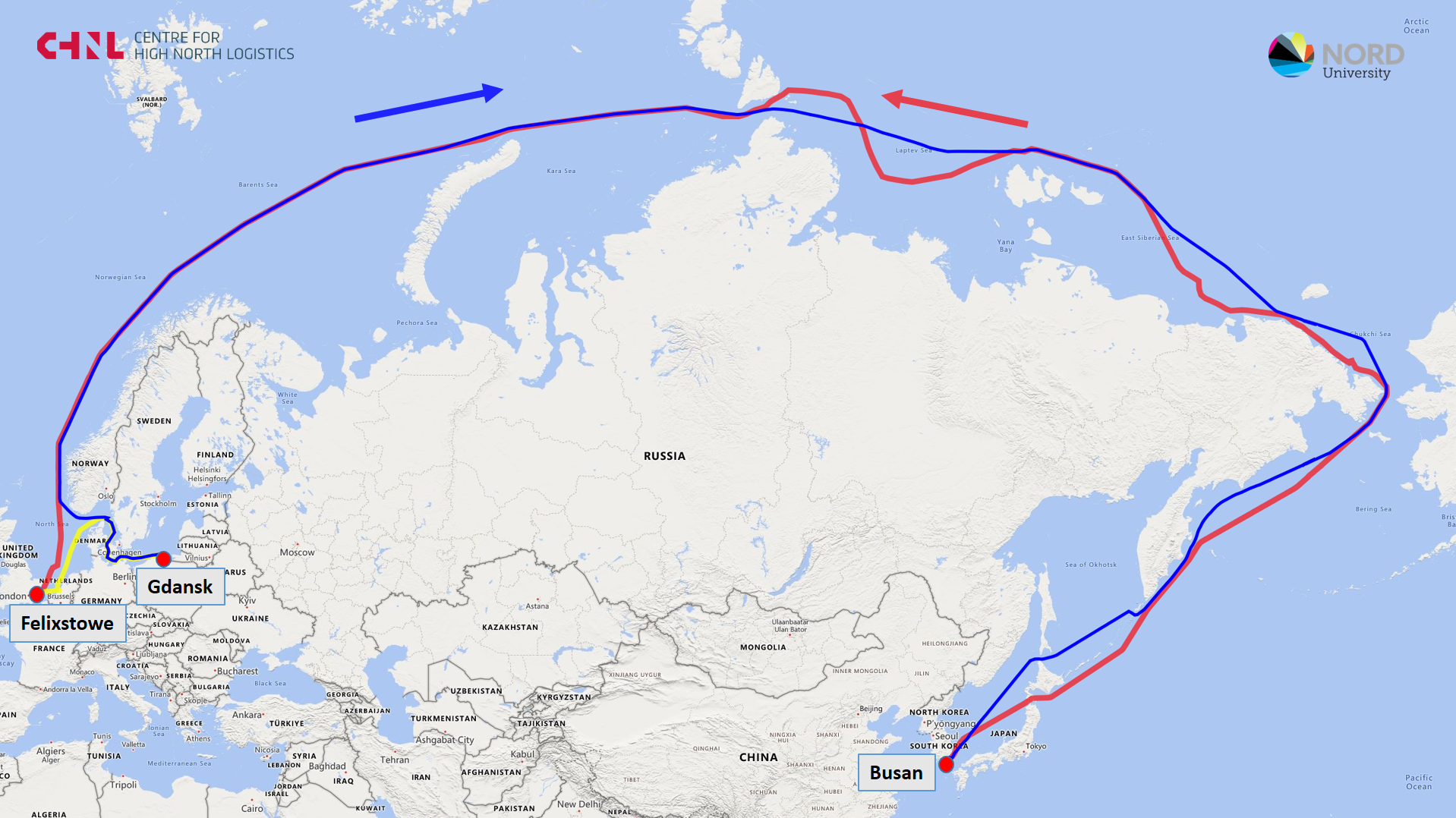
Figure 1. Westbound and eastbound voyages completed by Panstar Acro during its 2026 round voyage via the NSR. Red line: Busan-Felixstowe westbound voyage. Blue line: Gdansk-Busan eastbound voyage. Source: AIS data by Kpler MarineTraffic platform; map prepared by CHNL.
Following our earlier report of 10 September 2026, the South Korean container vessel Panstar Acro (IMO 9571313) has successfully completed its European port rotation and the return eastbound transit via the Northern Sea Route (NSR), arriving back in Busan on 10 October 2026.
This review is based on AIS data provided through the Kpler MarineTraffic platform and information from open sources. Distances, transit times and average speeds presented in this article were calculated using AIS tracking data.
The completion of the voyage marks the conclusion of South Korea’s 2026 pilot NSR container shipping project. In total, the full round-trip operation from departure in Busan on 22 August to arrival back in Busan on 10 October took approximately 49 days and 11 hours, covering a cumulative distance of 16,385 nautical miles.
Completion of the Westbound Voyage
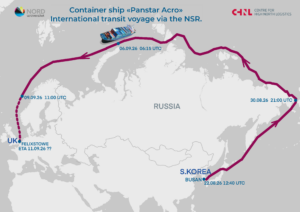
After exiting the NSR waters at Cape Zhelaniya on 6 September 2026 at 06:15 UTC, Panstar Acro proceeded along the Norwegian coast toward the United Kingdom. During this post-NSR transit leg, the vessel covered 2,189 nautical miles in approximately 5 days and 14 hours at an average speed of 16.4 knots. The container ship arrived at its first European port of call, Felixstowe, on 11 September 2026 at 20:00 UTC, closely matching the previously estimated arrival window. In total, the westbound voyage from Busan to Felixstowe covered 7,577 nautical miles and was completed in approximately 20 days and 7 hours. According to final figures from South Korea’s Ministry of Oceans and Fisheries, the outbound cargo comprised 737 TEU of loaded export containers and 202 TEU of empty containers, totaling 939 TEU.
Operations in European Ports and Return Cargo
While initial commercial schedules for the return leg (Voyage 001E) included four European port calls—Felixstowe, Rotterdam, Hamburg, and Gdansk – the vessel omitted the call at Hamburg and conducted operations across 3 terminals. Following a port stay of 1 day and 2 hours in Felixstowe, the vessel departed for Rotterdam on 12 September at 22:00 UTC. The short 126 nautical mile crossing took approximately 12 hours at an average speed of 11.0 knots.
Figure 2. European port rotation of Panstar Acro between Felixstowe, Rotterdam and Gdansk, 11-19 September 2026. Source: AIS data provided by Kpler MarineTraffic platform; map prepared by CHNL.
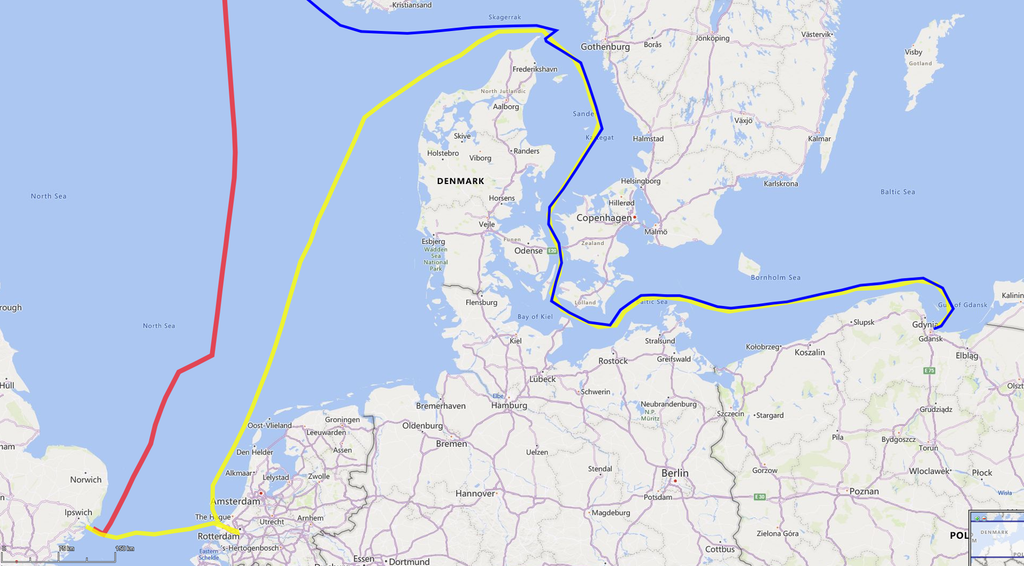
In Rotterdam, Panstar Acro remained at berth from 13 September (09:30 UTC) to 15 September (02:00 UTC), spending roughly 1 day and 17 hours in port. The vessel then sailed 1,022 nautical miles into the Baltic Sea at an average speed of 14.8 knots, arriving in Gdansk on 17 September at 23:00 UTC after 2 days and 21 hours underway. The final port stay in Gdansk lasted 1 day and 2 hours. Overall, the European phase of the voyage lasted 7 days and 5 hours, comprising approximately 3 days and 21 hours at berth and roughly 3 days and 9 hours of steaming between European ports (1,148 nautical miles).
According to the Ministry of Oceans and Fisheries, despite earlier commercial bookings opened for the eastbound leg, the vessel returned to Busan without commercial import cargo. Instead, the European port calls were utilized for equipment repositioning, with Panstar Acro loading 1,743 TEU of empty containers for the return voyage to Asia.
Return Eastbound Voyage via the NSR
Panstar Acro departed Gdansk on 19 September 2026 at 01:00 UTC to begin its eastbound return voyage to South Korea. On the NSR approach leg, the vessel sailed 2,508 nautical miles in approximately 6 days and 20 hours at an average speed of 15.3 knots, reaching the western boundary of the NSR at Cape Zhelaniya on 25 September 2026 at 20:50 UTC.
Figure 3. Eastbound voyage of Panstar Acro from Gdansk to Busan via the Northern Sea Route, September-October 2026. Source: MarineTraffic platform.
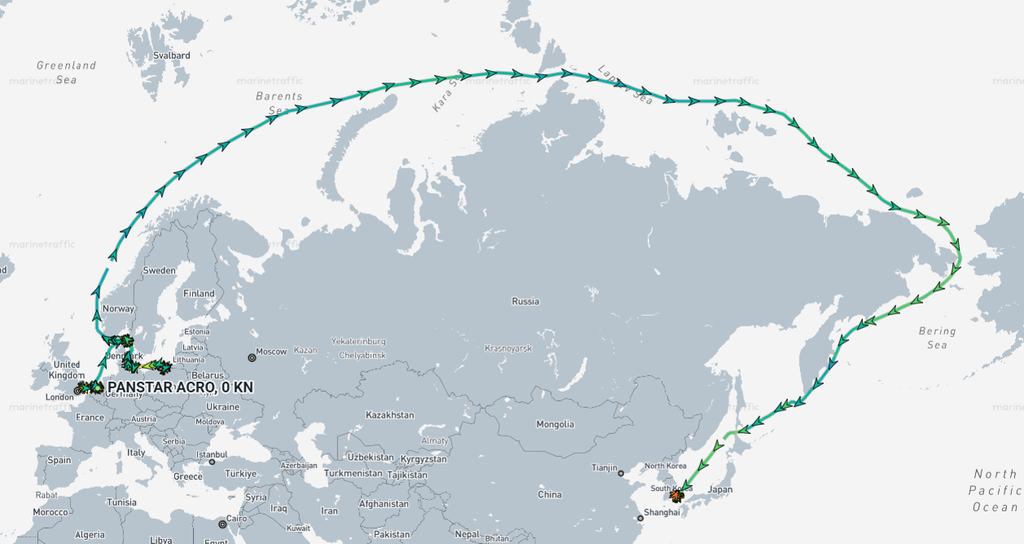
Between 25 September (20:50 UTC) and 1 October (17:40 UTC), the vessel transited the NSR from west to east. It covered the 2,115 nautical mile Arctic passage in approximately 5 days and 21 hours while maintaining an average speed of 15.0 knots. As on the outbound passage, the eastbound NSR transit was completed independently without icebreaker assistance.
After exiting the NSR at Cape Dezhnev on 1 October at 17:40 UTC, the vessel proceeded south through the Bering and East Seas. This final 3,037 nautical mile Pacific leg took approximately 9 days and 6 hours at an average speed of 13.7 knots. Panstar Acro arrived in Busan on 10 October 2026 at 23:30 UTC, completing the 7,660-nautical-mile eastbound voyage from Gdansk in approximately 21 days and 23 hours.
Comparison of NSR Transits and Voyage Summary
A comparison of the 2 Arctic passages highlights consistent operational performance within the NSR. Across both legs, Panstar Acro maintained identical average speeds in NSR waters, recording 15.1 knots westbound and 15.0 knots eastbound.
Table 1. Key voyage metrics for the westbound and eastbound voyages of Panstar Acro completed via the NSR in 2026. Source: AIS data by Kpler MarineTraffic platform; calculations by CHNL.
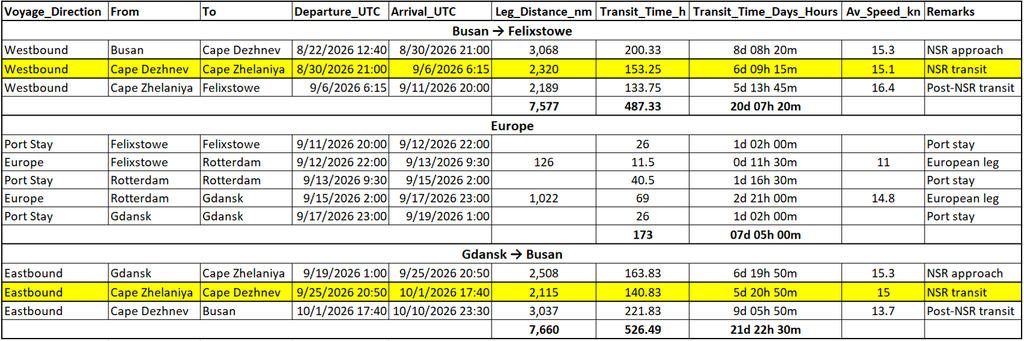
The eastbound transit through the NSR was approximately 205 nautical miles shorter than the westbound passage (2,115 nm versus 2,320 nm) and required approximately 12 hours less transit time (5 days 20 hours 50 minutes versus 6 days 9 hours 15 minutes).
For comparison, voyage planning calculations indicate sailing distances of approximately 10,877 nautical miles between Busan and Felixstowe and 11,788 nautical miles between Gdansk and Busan via the Suez Canal. The corresponding NSR voyages completed by Panstar Acro covered 7,577 and 7,660 nautical miles respectively. At a service speed of 16 knots, the Arctic route reduced transit time by approximately 8 days on the westbound voyage and nearly 9 days on the eastbound voyage.
Overall, the completed voyage provides an additional operational example of container vessel transit via the Northern Sea Route during the late-summer and early-autumn navigation season. The westbound and eastbound Arctic passages were completed in approximately 6 days each, with average speeds of about 15 knots in both directions.